Only 2 more days until the return of NECyto’s fall meeting! I know you have all been anxiously awaiting the itinerary, you will find it pasted below. Please note, our hosts have asked that we use the entrance on Fulkerson Street (the star on the map) just around the corner from the Binney Street entrance.
And our itinerary for the day, I look forward to seeing everyone! –Mike
Hello flow community! I hope everyone had a fun Halloween, only 10 days until NECyto 2025 on Thursday, November 13! I’m pleased to announce our speaker lineup for this year, we will post the agenda and actual order of talks later this week:
Hsiao Hsuan Kuo, Moderna Tx: “Functional Profiling Using High Parameter Spectral Cytometry for Clinical Phase Studies in Vaccine Development”
Daniel Vocelle, St Jude Children’s Research Hospital: “Applications of Imaging Cytometry: From Technology to Discovery”
Spencer Shah, Broad Institute: “Exploring the use of imaging-based flow cytometers for functional genomics”
Mikhail Roshal, Memorial Sloan Kettering Cancer Center: “Myeloid neoplasms through the lens of high parameter flow cytometry”
Wayne Austin, Beam Tx: “Epitope engineering for in vivo enrichment of gene edited therapies”
To register, visit https://www.eventbrite.com/e/necyto-2025-tickets-1736133153999?aff=oddtdtcreator We appreciate the hospitality of our hosts, Moderna. There are additional security registration steps required, so please register this week if you can! All activities for the meeting will be at the Moderna facility at 325 Binney Street, Cambridge MA. Registration and breakfast starts at 8, and we will be heading back to MEX on Main Street, Cambridge, for the “Impromptu BBG” after the meeting.
On behalf of the organizing committee, we hope you can join us, and meet the new committee members! Mike Waring President
Another year has passed, and the annual Fall meeting is back! We are all settled into our new spaces, and this years meeting will also be in a new space: the Moderna Facility on Binney Street in Cambridge MA. Join us on November 13th for 5 talks and a vendor fair. We will be releasing the speaker list next week, as we finalize the talk titles. I was cleaning out some papers and came across the agenda for our “Immunity and Immune Function in AIDS–Cytometric Methods” meeting from October 5, 2004, if you want to see what we were talking about 21 years ago click here!
We also have a few new committee members joining us this year, so we look forward to introducing them. There will be an “Impromptu BBG” after the meeting.
There will also be a “scheduled” BBG on Monday November 3, we hope you will join us for one or both of the upcoming events! Keep an eye on the mailing list for details (you can sign up on the “contact us” page).
Hello New England Cytometry users! I cant believe its been almost a year since the last post here, I had sent out notices on the mailing lists and social media that we would be skipping the fall meeting this year, but never posted it here! We are still getting settled into our new building for the Ragon Institute, and there are lots of changes. We do have an open position in the flow core, there is a technician level job posting here: https://partners.taleo.net/careersection/ex/jobdetail.ftl?job=3301915
but we are also considering a more experienced position instead, so if you have 5+ years and would be interested in joining our team, let me know!
Monday October 7 we will have our monthly happy hour (or “BBG”) at MEX in Cambridge (500 Technology Square), across the street from the new building (600 Main Street). I’ll be happy to bring folks over in smaller groups to see the new space. Go to the “Contact us” page for the link to sign up for our distribution list if you arent on it already. Looking forward to seeing some of you soon!
Mike W
A HUGE Thank you to all of the attendees and vendors that joined us on October 12th for our fall meeting! Presentations are posted to the “Meetings” page, and it looked like everyone had a great time at MEX for the happy hour! The hostess said we were a really fun group and they’d be happy to host us again, so thank you everyone for being on your best behavior!
In over eleventy one months of running our social media accounts, I update half of them half as often as I should like, but I hope you like more than half the posts half as well as they deserve! We will try to post more in the coming year. We were thrilled to have Akos bring his camera, and he was busy all day! Enjoy the pictures on Facebook and Instagram, hopefully more to come. If you have any pictures to share, please send them our way or post them to the page!
Our 2023 fall meeting is only 2 days away! We will be able to provide parking at the 800 Tech Square Garage for $10 for the day, look for the signs for NECyto. Registration and check-in will be in the atrium of 100 Tech Square, vendors please do not enter before 7AM, attendees are invited to come for breakfast starting at 8AM. Talks will begin at 9am in the first floor auditorium of 400 Tech Square across the street. Attendees and vendors are invited to attend a post-meeting gathering at MEX in 500 Tech Square, lets keep the conversations going! We are looking forward to seeing everyone!
Registraion for the 2023 New England Cytometry User group meeting on Thursday, October 12, 2023 is now open! Use the button below to register on Eventbrite:
The meeting will be held at 400 Technology Square in Cambridge MA in the Ragon Institute’s Schwartz Auditorium for a day of talks, and a vendor fair in the atrium of 100/200 Tech Square. Breakfast will be available at 8. Speakers will include Sami Farhi (Broad Institute), Vera Tang (University of Ottawa), David Ng (University of Utah School of Medicine), Peter Lopez (NYU), Thomas Diefenbach (Ragon Institute), and a presentation from the Organizing Committee. Stick around afterwards for the “impromptu” happy hour. The full agenda will be posted to https://newenglandcytometry.com/meetings/ soon!
If you are retired and would like to attend, please contact us directly! Any vendors that are interested in additional sponsorship opportunities, also please reach out. Additional vendor information will be sent to registrants (venue access, shipping information).
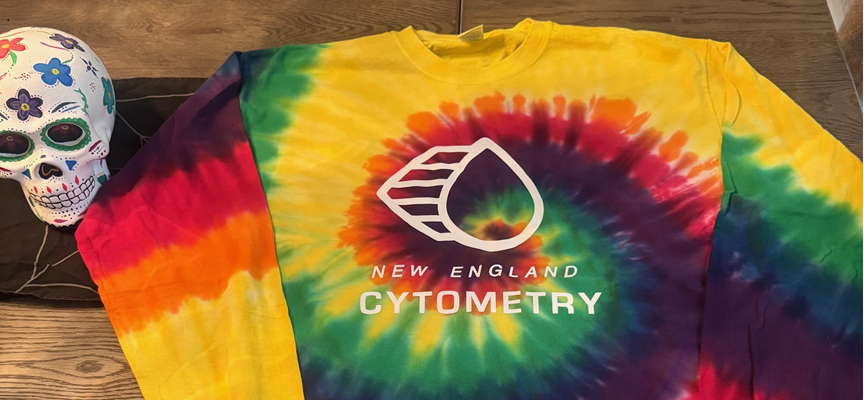
Please save the date for the 2023 Fall NECyto meeting, to be held on Thursday October 12, 2023 returning to the Ragon Institute at 400 Tech Square in Cambridge! We will be opening up the registration site in the next couple of weeks, along with announcing the speaker list, but I wanted to assure our community that the meeting is happening and we are looking forward to welcoming everyone to Tech Square one last time, before the big move across the street! Be sure to pick up this year’s t-shirt, having done the visible spectrum:
this year we’re going UV!
We hope you’ll be visible at the meeting!
Mike Waring President, NECyto User Group Director, Ragon Institute Imaging Core Facility
When setting your sort gates in Diva, there are some limitations that users need to be aware of that are not obvious, especially when it comes to gating on populations close to or below the axis.
I first encountered this issue when samples were either overcompensated, or (as discussed in the previous post) when small fluorescent particles pushed the baseline restore artificially negative, so that the population of interest was at or below 0. There is a minimum “upper limit” for your sorting gate, and if you set the region boundary below this, no events will be sorted (your sort rate and collected events will be 0, even though you see events in the gate on the plots). This is true for ANY gate in the hierarchy, so if your “sort gate” is a descendant of a gate that is set too low, you will not register any sorted events.
Setting the gate any lower than shown for APC will result in no events being sorted.
The next limitation to highlight is that Diva cannot distinguish a LOWER boundary that is less than this cutoff—if you are sorting below this minimum limit, then ANYTHING below that is considered “in the gate” regardless of what lower boundary you set. In this example, region P5 is set around only the orange population, but in the post sort analysis on the right, you can see the green population was ALSO sorted.
Lastly, if you were going to try to sort just the green population, you could set at least one point of the gate above that “minimum threshold” value to get around that “minimum threshold” and get events to sort, and exclude the orange population from your gate, but you would end up still sorting both as it will sort anything below that minimum threshold value regardless of if it is gated or not. Again, post sort shows that even though only the green was gated, both green and orange populations are present in the post-sort sample.
We have found this to be true on both the Arias as well as the S6—The S6 allows for up to 16 gating levels vs. the Aria’s limit of 8, but still cannot distinguish gating below 0.
(I set this up with calibrite beads, FITC is green, PE is orange, then unstained and APC are the blue. I purposely overcompensated FITC from APC, and PE from APC, to push the populations below 0 but still be able to distinguish them.)
In the course of running experiments in Diva, you may have found that your negative population ends up well below 0. This came up in a Purdue post in 2009 and Mario Roederer gave an in-depth explanation (https://lists.purdue.edu/pipermail/cytometry/2009-June/037462.html). I’ve put together a write-up with pictures that I share with my users and thought it would be helpful to post it here.
Baseline Correction and potential issues
In order to remove background signals due to unbound fluorophores, dark current, and ambient light, the Diva Software averages signals between events and subtracts this from the total signal. If there is no signal for that parameter, this can result in a negative value for that event.
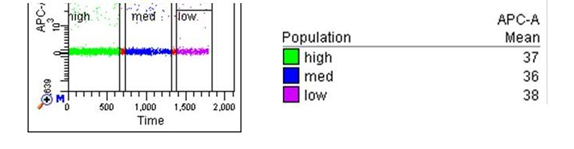
Most of the time, signals are corrected appropriately and this results in a population mean that is consistent regardless of flow rate. (You may possibly see a higher CV/more spread at higher flow rate due to greater measurement error). Population labels to the right refer to the flow rate used for acquisition of the events in that gate.
Where it can go wrong
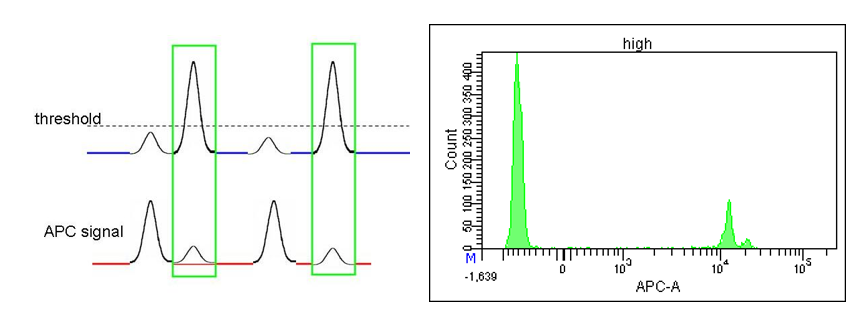
Usually threshold is set on FSC– in cases where particles are very different in size, one may be below threshold while the other is on scale (such as cells vs. beads or debris). Because it is below threshold and is not an “event”, the fluorescent signal of the small particle is averaged into the baseline and subtracted from the signals. In this example, negative cells and fluorescent beads are in the same sample. The beads are so small they fall below FSC threshold and are ignored. Their bright fluorescent signal is averaged into the “baseline” which is subtracted from the signal measurement This can lead to your negative populations shifting artificially far into negative values and can lead to problems with your data files. Here the positive APC peak is either a bead that managed to generate FSC above threshold, or stuck to a cell.
Confirming issue:
One way this issue can be illustrated is to run at different flow rates. The higher the flow rate, the more “undetected” particles that will be present, and the higher the baseline error so the further into the negative your population will go. (If your population doesnt go further into the negative with higher flow rates, then it may be a compensation issue).
Solution:
One way to accommodate this is to apply a second threshold using the fluorescent parameter where the bright small particles are occurring (we often see it with PE antibodies that have aggregated):
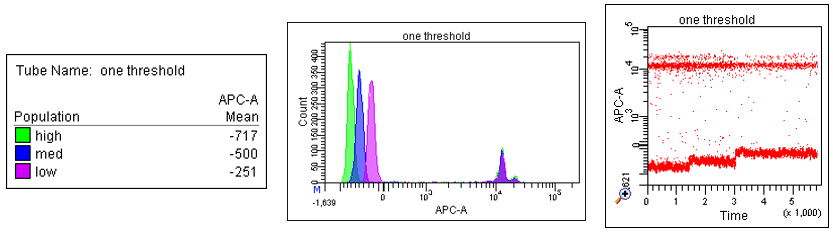
Applying a second threshold that identifies the small particle based on fluorescence makes sure all events are detected and the baseline is not erroneously high—events above T1 OR T2 will be recognized and recorded. The large APC+ peak below consists of the beads being detected by fluorescence threshold:
Alternatively, you can decrease your FSC threshold to include the debris, but you may not be able to set it low enough to detect all of them, or may end up in the FSC noise. This also defeats the purpose of a higher threshold being used to crop out unwanted debris events in the data file. Another option would be to set a “Save gate” using a FSC threshold, so that the small particles are recognized during acquisition but not saved in the data file.
From BD’s whitepages: 2.5 Baseline Restoration PMT signals can contain a high level of background from a variety of sources: light from unbound fluorophores, PMT dark current, and ambient light. Background signal is eliminated in two stages. The first, gross adjustment is made during the initial conversion of the signal from current to pulse. (Photomultiplier tubes are a source of current.) After pulse conversion in the preamp, the output signal falls in the range of 0 to 5 V. This initial gross adjustment preserves the dynamic range of the A/D converters for signals of interest, and maintains a safety margin of 100 mV. The second, final adjustment is made just before area and height are measured. The FPGAs (Figure 2) calculate a running average of the data outside any window gate to remove the last 100 mV (Figure 3).






 New England Cytometry